Technical SEO Release Gates for JavaScript Sites: Compare Source and Rendered HTML
A paired comparison sheet for title, canonical and content, with six fictional release decisions.
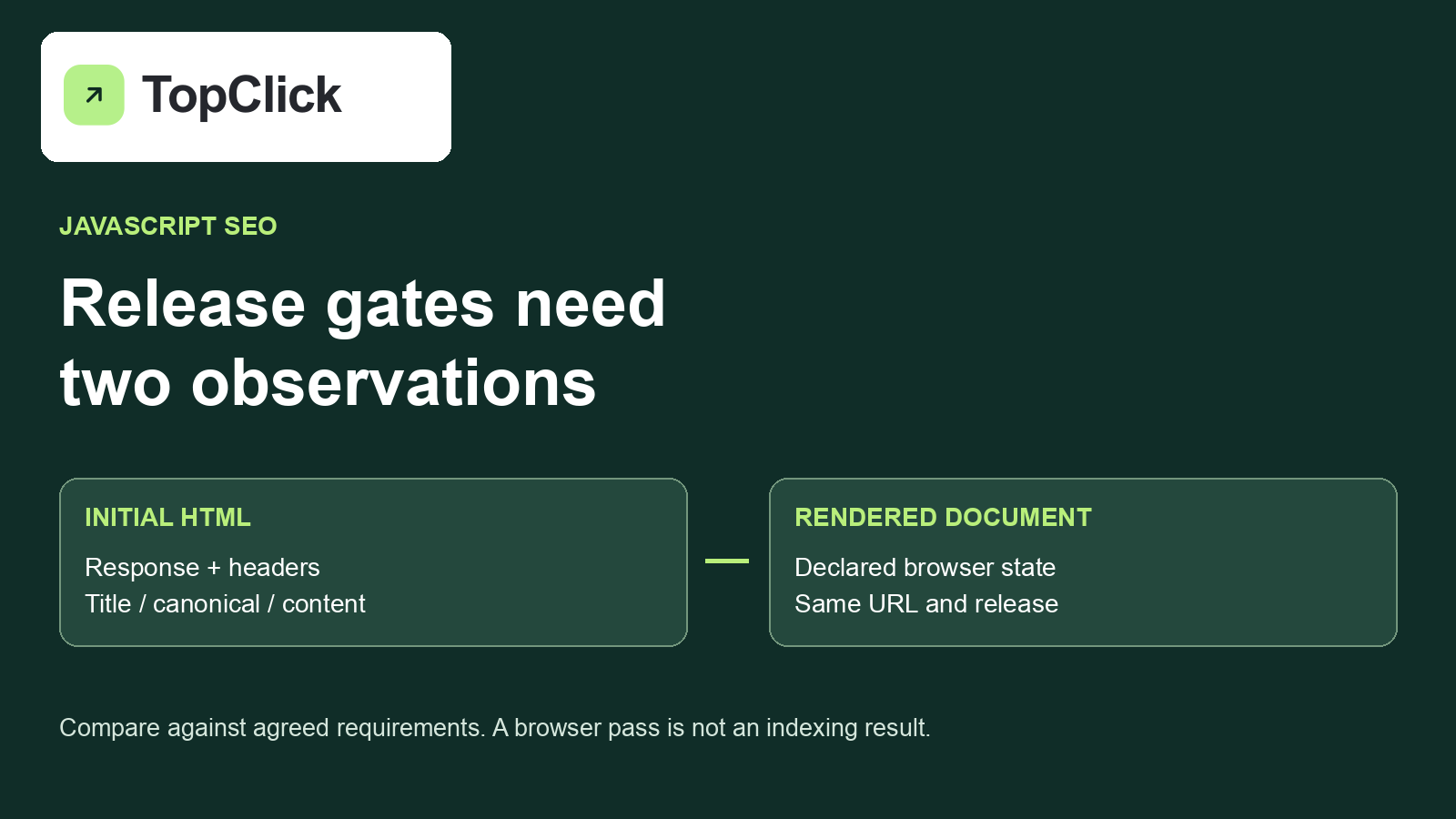
A JavaScript release can preserve the screenshot while changing the page title, replacing a canonical URL or removing a meaningful passage during hydration. A release review needs evidence of those changes at the same URL and under a declared browser state. Looking at the finished screen alone leaves the initial response unexamined.
Use a paired comparison: retain the initial HTML response, capture the browser document after a defined readiness condition and evaluate both against the page's agreed requirements. Source and rendered HTML do not have to be identical. The useful question is whether each required signal remains present, consistent and attributable to the release being assessed.
This article proposes a comparison sheet and six fictional release cases. They are a specification exercise, with supplied observations for explaining the decisions. No customer website, production deployment or Googlebot rendering test was performed. Adapt the fields to your actual templates before using the sheet as a release gate.
Define what a comparison can establish
A source-versus-rendered comparison establishes what two captured artifacts contain. It does not establish which canonical Google selected, whether a URL is indexed or how a page will rank. Keep those later observations in separate fields. A passing browser check should never automatically populate an indexing result that nobody has retrieved.
Start with one URL and an explicit page requirement. For a service page, that might mean a descriptive title, one intended canonical declaration and a named service explanation visible after rendering. Specify the expected values or acceptance conditions before inspection. Otherwise, the reviewer can unconsciously redefine success around whatever the new build happens to show. The initial response is the HTML delivered for the recorded request. The rendered artifact is the document observed in a particular browser session after JavaScript has run to the chosen condition. Request headers, cookies, redirects and locale can affect these artifacts. They therefore belong to the evidence record rather than being treated as incidental troubleshooting details.
Keep comparison and approval separate. The person collecting artifacts can report a mismatch without deciding its commercial acceptability. A named release owner decides whether the mismatch blocks the affected route, qualifies for an approved exception or needs another observation. That division makes an unresolved result visible without turning every difference into an automatic rejection.
Record the capture contract before opening the page
Give the sheet a release identifier and a capture pair identifier. Record the requested URL, final response URL, redirect chain, response status and collection time. Add the build identifier or other available deployment evidence. A timestamp without a release connection cannot distinguish a regression from a comparison between two unrelated versions. Describe the browser environment: browser version, viewport, locale, authentication state and consent choice. For a public service page, begin with an unauthenticated state unless the requirement says otherwise. Retain any legitimate variation as a separate case. Do not combine an English source response with a remembered French browser session and call the changed title a regression.
Declare readiness in terms of the page's behavior. An application may expose a documented completion marker for its main content, or the test may wait for specified content and a route-specific heading. Record the actual rule and any timeout. A fixed delay alone does not explain whether the required data arrived before the capture. Save the response body and headers separately from the browser document. Keep a screenshot for visual context, but retain searchable text or HTML for the actual comparison. Include collection errors. If a response body could not be retained, label that side unavailable; a later browser screenshot cannot reconstruct what the server originally returned.
Give every signal its own comparison row
Avoid one overall field labeled SEO passed. Use a row for each signal, with the source observation, rendered observation, expected condition, evidence reference and disposition. Counts matter alongside values. A page with two title elements or conflicting canonical declarations should not be reduced to whichever value an extraction convenience happened to return first.
| Signal | Source evidence to retain | Rendered evidence to retain | Question for the gate |
|---|---|---|---|
| Title | Every title element and its text | Every title element and the browser document title | Does the agreed route title survive the rendering path? |
| Canonical | Every declaration and its raw target | Every declaration, raw target and resolved target | Is there one consistent intended canonical? |
| Meaningful content | Required passages and relevant link targets | The same named passages and their visible state | Can the intended reader still obtain the required information? |
| Indexability inputs | Status, robots metadata and relevant headers | Robots metadata after rendering | Is an unresolved directive conflict being hidden by the final screen? |
Add one evidence reference per artifact rather than pasting the entire page into every row. A useful reference identifies the retained file and relevant section. Keep raw observations alongside interpreted results. If a tool normalizes whitespace or resolves a relative URL, record that transformation so another reviewer can repeat the interpretation from the same input. The table is deliberately small. Add structured data, hreflang or other signals when the release can affect them, using their own requirements and validators. Their presence in a document does not establish validity. Expanding the sheet should add a concrete decision field, rather than a long collection of checks with undefined owners.
Exercise both direct loading and route transitions
For a single-page application, direct loading and client-side navigation are separate entry paths. Open the target URL directly in the declared starting state, then repeat the relevant transition from another route. Record both pairs. An implementation can set the correct title on direct load yet retain the previous route's title during navigation.
Use a small representative route inventory tied to the changed templates. Include a route with ordinary content, a parameterized route if relevant and a missing-content case. Name why each route was selected. A sample supports conclusions about that sample; it does not demonstrate that every URL on the site behaves the same way. Separate successful content loading from dependency failure. If the page depends on an API, agree how an unavailable response will be represented in the review. The collection record should show whether content was absent, still loading or replaced by an error state. Those conditions require different investigation and may have different indexing implications.
Record cache conditions when they matter. A new HTML document paired with an older JavaScript asset can produce a different result from a clean load. Keep the actual asset identifiers available to the reviewer. Do not clear state, obtain a passing result and discard the failing artifact without documenting why the original state occurred.
Walk through fictional release R-42
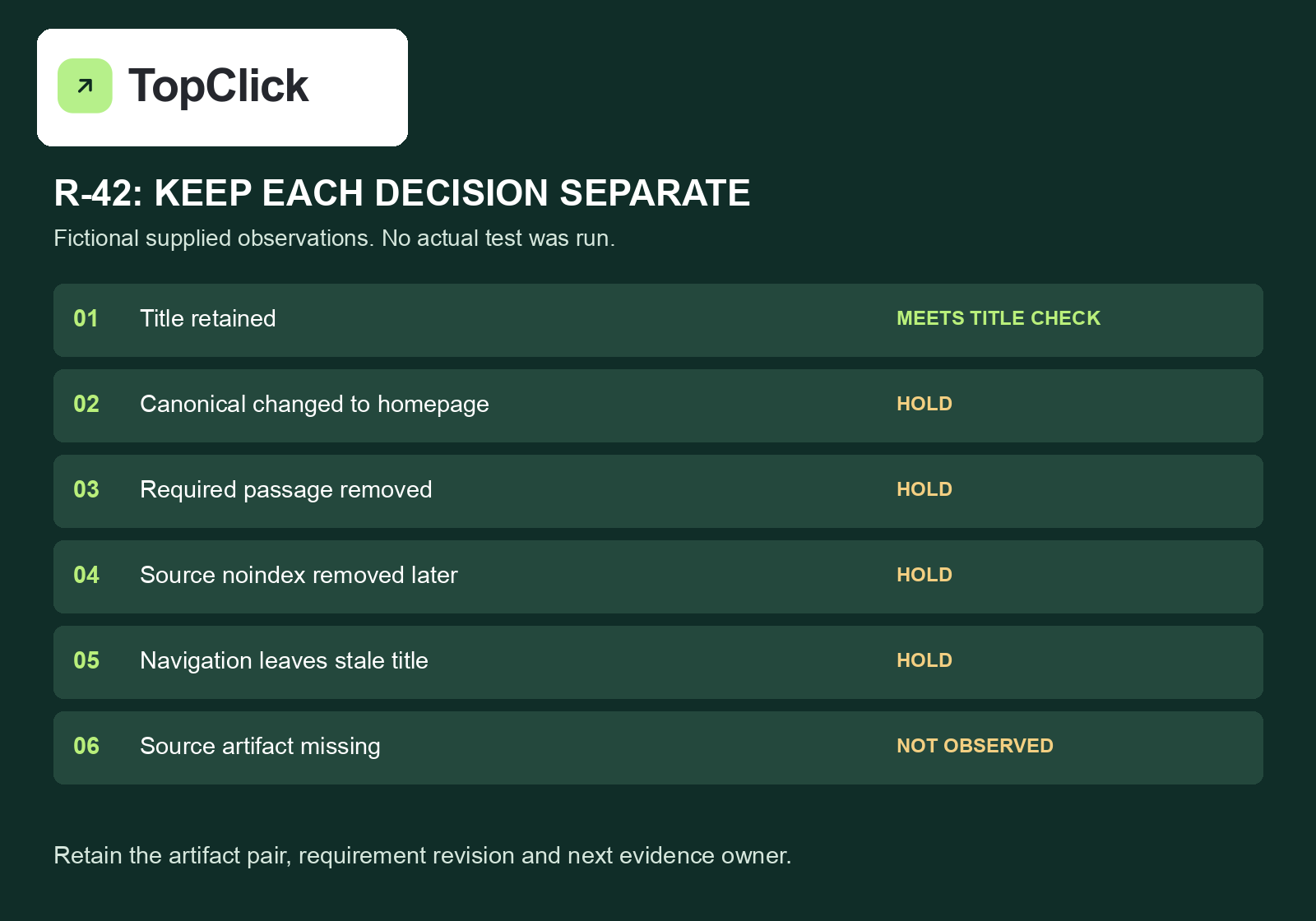
Fictional R-42 worksheet. Supplied observations illustrate individual dispositions; no deployment or browser test was performed.
Assume R-42 changes a shared service-page component. The intended English title for /services/search-review/ is Search Review Services. Its intended canonical is https://example.com/services/search-review/. The required content explains the review scope and identifies the receiving implementation owner. These values and the observations below are invented for the worksheet, not collected measurements.
| Case | Supplied comparison | Proposed disposition | Next responsible evidence |
|---|---|---|---|
| R42-01 | Source and rendered title match the intended route title | Meets this title check | Reviewer retains both title inventories |
| R42-02 | Source canonical points to the service route; rendered canonical points to the homepage | Hold canonical acceptance | Frontend owner explains and corrects the changed target |
| R42-03 | Source contains the scope passage; rendered page removes it | Hold content acceptance | Component owner supplies the corrected capture pair |
| R42-04 | Source has noindex; the browser removes it after loading | Hold indexability acceptance | Delivery owner supplies corrected response evidence |
| R42-05 | Direct load sets the title correctly; navigation retains the previous route title | Hold transition acceptance | Routing owner repeats both entry paths after correction |
| R42-06 | The response artifact is missing and the final browser screen looks correct | Not observed for the source side | Collector retrieves a valid source artifact |
Each disposition applies to the stated row. R42-01 does not approve R-42 as a whole, because the other supplied cases contain unresolved requirements. R42-06 is an evidence gap rather than proof that the source is defective. Keeping these distinctions prevents a missing file from being reported as either a technical failure or a successful test. For a real execution, replace supplied observations with retained artifacts and actual collection times. Keep the case identifiers stable so a correction can reference the original finding. Add the new observation as a later revision instead of overwriting the evidence that led to the hold. The worksheet then explains why a release decision changed.
Check titles against route requirements
Collect every title element in the response and rendered document. Compare their texts to the approved route requirement, preserving meaningful differences such as service names and locale. Normalize incidental whitespace only under a recorded rule. A comparison that strips every changing word can hide the exact regression the title check was supposed to detect.
Do not require source and rendered titles to match merely because equality is easy to automate. A site may intentionally provide a useful server title and refine it after authorized localization. The acceptance rule must describe that variation and the state that permits it. Unexplained variation remains open, even if each title looks plausible in isolation. A duplicated title requires investigation of the declarations, rather than a decision based only on the browser tab. The displayed tab text is useful corroboration but is not an inventory of head elements. In a transition case, retain the previous route and destination route so the owner can reproduce stale metadata caused by navigation.
Close a title finding only against the corrected release and matching capture conditions. A local component preview may demonstrate a proposed fix while leaving the deployed route unverified. Label that scope precisely. The release gate needs the evidence required by its own agreement, including any post-deployment confirmation assigned to a different person.
Preserve canonical declarations before interpreting them
For canonicals, retain both the literal attribute value and its resolved URL, together with the document URL used for resolution. Record all declarations. Do not silently collapse multiple values, follow a convenient link and replace the original target in the sheet. That removes the information needed to explain a conflict between server output and JavaScript changes.
Google's JavaScript SEO guidance advises keeping a JavaScript-set canonical consistent with the original HTML and avoiding conflicting declarations. Apply that guidance to R42-02: the rendered homepage target conflicts with the supplied service-route target. The proposed hold concerns that conflict; it does not assert which URL Google has actually chosen.
Keep the intended target distinct from the selected canonical reported by a search engine. Google's canonicalization documentation describes several signals used in canonicalization. A correct declaration is an implementation observation. It is not a guarantee that the declared target becomes the selected canonical or receives a particular search result treatment. When a canonical requirement changes deliberately, record who approved the new target and which routes are affected. Then compare the release against that revision. Otherwise, a reviewer may accept a changed target as intentional based on a verbal explanation that the receiving team cannot later verify. Preserve the target decision with the same care as the captured HTML.
Compare meaningful content with declared tolerances
Choose passages that carry the page's actual job. On the fictional service route, the scope explanation and receiving-owner statement are the required content. Record their source presence, rendered presence and visible state. A large word count elsewhere in the document cannot compensate for removal of the specific passage the reader needs.
Distinguish DOM presence from visibility. A passage can remain in the document while a component hides it or leaves it behind an interaction that the capture did not exercise. Record the observed state without assuming every crawler or reader follows the same interaction. Use the screenshot to explain visibility and the retained document to establish the underlying content observation.
Declare tolerances for legitimate variation. A changing timestamp or an authorized personalized greeting may be irrelevant to this route's acceptance. The service scope itself may be essential. Keep these categories explicit so normalization removes incidental variation without erasing a meaningful content loss. If the tolerance changes during review, preserve its revision and the reason. Links inside required passages can deserve separate rows. The words may survive while a destination changes to an unrelated route or an empty placeholder. Retain the visible anchor and actual href, resolving relative destinations under the documented base. That makes the content check useful to the receiving team without pretending to be a complete crawl or link audit.
Treat indexability inputs as a separate gate
R42-04 illustrates why the finished browser state is insufficient. Google states in its JavaScript SEO documentation:
If you do want the page indexed, don't use a noindex tag in the original page code.
The quotation is from Google's guidance on robots metadata and JavaScript. It concerns the original page code. Removing an initial noindex in a browser session is therefore insufficient evidence for accepting an indexable release. The delivery owner needs to correct and recapture the relevant response.
Inspect the response status and relevant headers as well as HTML metadata. A browser document does not preserve every indexing directive supplied in the response headers. Google's robots meta tag and X-Robots-Tag documentation provides the directive definitions. Keep header observations in the sheet even when the page appears normal to a person. Crawl access and indexing directives ask different questions. A successful manual browser visit does not establish that Google can retrieve the same route and required resources. Conversely, absence of an observed restriction is not proof of indexing. Assign any crawl-access verification its own evidence source, authorized environment and owner instead of inferring it from the screenshot.
For real search-engine observations, use the appropriate URL Inspection information and record whether the evidence describes an indexed version or a live test. These are different observations with different times. Keep them linked to the release review, without retroactively relabeling a local browser capture as Google's rendering of the page.
Decide with dispositions that preserve uncertainty
Use four explicit outcomes for an individual row: meets the agreed check, hold, accepted exception or not observed. A hold identifies a requirement that remains unsatisfied under the recorded comparison. Not observed means the necessary evidence is missing or unusable. An accepted exception needs an accountable decision, its affected scope and any expiry or follow-up condition.
A row that meets the agreed check should identify the requirement revision and both artifact references. Avoid a general statement that the site is SEO compliant. The retained evidence concerns particular signals, routes and entry paths in a particular environment. Additional checks can expand that scope, but a broader conclusion requires the corresponding observations.
Make the next action specific. A canonical mismatch goes to the owner of the canonical-producing component; a missing response capture goes to the collector; a changed business requirement goes to its decision owner. Include the requested artifact and the condition that will reopen review. A generic assignment to fix SEO leaves responsibility and completion undefined. For a correction, retain the original row and add the new capture pair. Compare like conditions or explain the changed environment. Recheck affected shared templates where the component change can propagate. Then let the authorized reviewer change the disposition. Preserving this chain makes the final approval understandable without requiring someone to remember the entire investigation.
Keep a capture failure from becoming a page verdict
A collector can fail independently of the page. A saved file may contain an authentication screen, an intermediary error or a response from an earlier redirect. Check the final URL and response identity before comparing its title to the target route. If the artifact belongs to another document, mark the capture invalid and retain the reason. Do not report the authentication screen's title as a regression on the service page. A timeout also needs its actual observation. Record whether the browser showed a loading state, an error state or the required content before the agreed limit. If the collector stopped before readiness could be evaluated, keep that collection failure separate from a demonstrated application timeout. This distinction determines whether the next action belongs to the capture process or the component owner.
Keep secrets out of shareable evidence. Response headers and browser documents may contain session identifiers or private account information. Use authorized public-page captures where possible, and prepare a redacted handoff copy when necessary. Retain a clear relationship between the restricted original and the shareable copy so redaction does not silently change the evidence used for the decision. The receiving engineer should be able to identify the two artifacts without repeating a production action. A comparison sheet that requires logging into a live customer account just to understand the finding has an avoidable dependency. Supply the relevant retained excerpts and their context under the project's access rules, with a named route for requesting any restricted originals.
Reopen the gate when its assumptions change
A release decision applies to the captured build and requirement revision. A later configuration change can alter metadata even when the application code stays the same. Content management updates, locale defaults and route mappings can also change the comparison. Record which of these inputs the acceptance depends on so the owner knows when a new observation is required. If a rollback is used, verify the restored route under the same contract rather than copying an earlier passing label. The deployed assets, content and configuration may no longer be the original combination. Preserve the rollback identifier and the new capture pair. A rollback action and a demonstrated restoration are separate entries in the record.
Assign the follow-up before closing the review. The collector should know which routes to recapture, the frontend owner should know which component behavior remains open and the release owner should know which exceptions require another decision. This handoff keeps the comparison useful after the meeting, when the next person must act from the recorded evidence alone.
Put the sheet into the implementation handoff
When commissioning help, name who collects the artifacts, who changes the code and who accepts the result. TopClick's technical SEO services cover JavaScript, technical specifications and verification, with the implementation route agreed in writing. The comparison sheet can help define the requested deliverable and receiving responsibility for that scope.
Ask for the route inventory, capture contract, comparison rows and unresolved decisions as usable handoff material. A report describing a suspected issue is different from a corrected deployed page. Identify whether implementation and post-deployment recapture are included, and which authorized access or developer input remains a prerequisite. The written scope should make those boundaries assessable.
R-42 ends with one supplied title match, four proposed holds and one source observation still missing. No release has actually been tested or approved. In a real review, those separate conclusions give the release owner a concrete next step: obtain the missing artifacts, correct the affected conditions and reassess the agreed rows against the relevant build.
More insights to read
- Test an AI Visibility Parser Against Missing Answers and Citation Links
- AI Visibility Baseline: Keep Mentions and Citations Apart
- How to Choose an AI Search Query Set Before Comparing Brands
- AI Search Services: What Must an Agency Hand Over?
- What Should an AI Search Pilot Buy Before a Monthly Retainer?
About the author

Dmytro Nasyrov. Photo supplied by the author.
Written by Dmytro Nasyrov PhD, software architect with 24 years of production experience. Dmytro is the CEO of TopClick.
About the author
- Software architect, Founder and CTO at Pharos Production
Comments
Join the discussionNo comments yet. Be the first to comment.